International Women's Day 2026: The Agency Gender Pay Gap
2nd Mar 2026
In our International Women’s Day 2025 report, analysing marketing professionals across agencies, brands, and commercial organisations, we identified a gender pay gap of 15.6%. Women were well represented at entry and mid-level positions and, in some cases, slightly outnumbered men at mid-career level. However, their representation declined at senior leadership levels, particularly across Head of, Director, and C-Suite roles. This reinforced an important conclusion: the gender pay gap was shaped not only by pay differences within roles, but by differences in progression into the highest-paid leadership positions.
One year on, the latest data from our 2026 Salary & Work Insights Survey allows us to examine agency leadership specifically and understand how progression and pay are evolving within this sector. The findings suggest that while women are clearly progressing into senior leadership roles in meaningful numbers, disparities remain at the very highest levels of agency leadership, particularly at Partner and C-Suite level, where representation and earnings diverge most significantly.
This distinction matters, because it reveals that the central question is no longer simply whether women reach leadership roles within agencies, but whether they reach the most senior and influential positions at the same rate as men – and how this ultimately shapes earnings, influence, and long-term career outcomes.
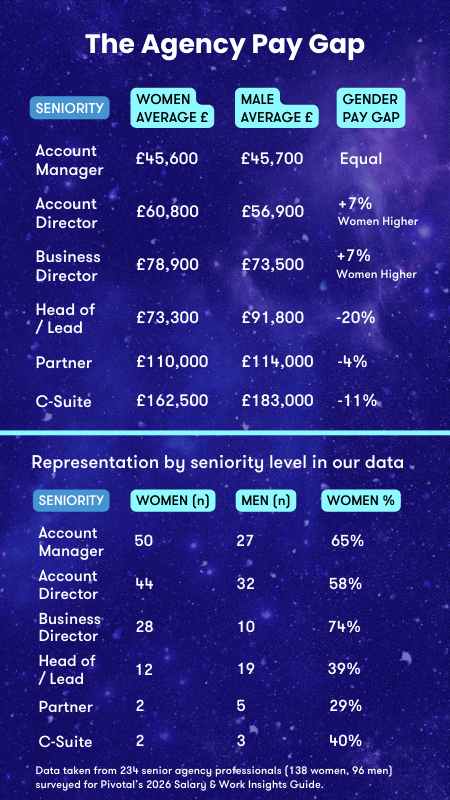
The glass ceiling has moved higher, but still exists
Women now form a substantial proportion of senior agency talent. In fact, at mid-senior leadership level, they represent the majority. However, this representation drops sharply at the highest levels of leadership.
Representation by seniority level in our data
| Role |
Women (n) |
Men (n) |
Women % |
Men % |
| Account Manager |
50 |
27 |
65% |
35% |
| Account Director |
44 |
32 |
58% |
42% |
| Business Director |
28 |
10 |
74% |
26% |
| Head / Lead |
12 |
19 |
39% |
61% |
| Partner |
2 |
5 |
29% |
71% |
| C-Suite |
2 |
3 |
40% |
60% |
Total sample: 234 senior agency professionals (138 women, 96 men)
Men are significantly more likely to hold top leadership roles
When grouping the most senior positions: Head, Partner, and C-Suite – men are substantially more likely to occupy these roles.
Leadership representation summary
| Leadership level |
Women |
Men |
| Head, Partner, or C-Suite |
16 (12%) |
27 (28%) |
Pay parity exists at mid-senior level, but reverses at C-Suite level
At mid-senior leadership level, pay is broadly equal – and in some cases, women earn slightly more. This mirrors what we’ve seen across in-house marketing roles. However, when examining earnings across all senior agency leadership roles combined, a clear gender pay gap remains. On average, women in senior agency positions earn £69,300, compared with £78,500 for men, creating a difference of £9,200 per year, or 11.7% lower average earnings for women.
Agency salary comparison by seniority
| Seniority |
Women Average |
Men Average |
Gender Pay Gap |
| Account Manager |
£45,600 |
£45,700 |
Equal |
| Account Director |
£60,800 |
£56,900 |
+7% (Women higher) |
| Business Director |
£78,900 |
£73,500 |
+7% (Women higher) |
| Head of / Lead |
£73,300 |
£91,800 |
−20% |
| Partner |
£110,000 |
£114,000 |
−4% |
| Executive / C-Suite |
£162,500 |
£183,000 |
−11% |
The gender pay gap is driven by progression, not entry
Importantly, the data shows that women earn salaries largely equal to their male counterparts at mid-senior leadership levels. Instead, the gap emerges higher up the career rung. It is at this level that male earnings accelerate sharply, while female representation and salary progression do not increase at the same rate.
This also mirrors our data across both in-house marketing and AdTech: The gender pay gap is not created at the point of entry into leadership, but at the point of advancement beyond it. In other words, the gap is both a pay issue and a progression issue.
Salary progression slows for women at the leadership transition point
While male salaries increase steadily and significantly as seniority rises, female salary progression appears to stall at this critical stage. For example, women at Business Director level earn an average salary of £78,900, but this figure falls to £73,300 at Head level, representing a decline rather than the expected increase associated with career progression.
By contrast, male salaries increase sharply over the same transition. Men earn an average of £73,500 at Business Director level, rising significantly to £91,800 at Head level. This divergence suggests that while women are progressing into leadership roles in strong numbers, they are more likely to do so in lower-paid leadership positions, while men are more likely to progress into higher-paid senior leadership roles.
What has changed since 2025, and what hasn’t
Our 2026 data shows a strong pipeline of women in middle and senior operational leadership, with women making up 65% of Account Managers (50 vs 27 men), 58% of Account Directors (44 vs 32), and 74% of Business Directors (28 vs 10). This clearly demonstrates that agencies have a substantial pool of experienced female leaders already operating at the levels that typically lead into senior leadership.
However, this progression does not continue at the same rate. Female representation drops to 39% at Head/Lead level (12 vs 19 men) and just 29% at Partner level (2 vs 5), showing that while women dominate much of the leadership pipeline, far fewer progress into the most senior roles. Although women represent 40% of C-Suite roles (2 vs 3), the small sample size reinforces how limited C-Suite representation remains overall.
Agencies clearly have a strong cohort of female leaders ready to step up, yet their careers are not advancing as consistently as men into the roles where influence and earnings are greatest. Addressing this imbalance is critical, not only for equality, but because diverse leadership teams are proven to deliver stronger decision-making, innovation, and long-term business performance.
Top of Form
Top of Form
Bottom of Form
International Women’s Day 2026: Give To Gain
This year’s International Women’s Day theme, #GiveToGain, emphasises the critical role organisations play in creating pathways to leadership and supporting progression beyond mid-career roles. The agency data illustrates just how important this support remains.
The largest disparities emerge past the mid-level point and where careers transition into senior leadership – where progression becomes less automatic, and more dependent on access to opportunity, mentorship, sponsorship, and visibility within organisations.
Supporting female progression into agency leadership shapes representation across the industry. Ultimately, it determines who holds the most senior positions, who shapes organisational strategy, and who defines the future of agency leadership itself. To learn more about this year’s International Women’s Day theme and how you can get involved, visit the official IWD campaign website.
Key Agency Findings
Representation
- Women represent 74% of Business Directors, but just 29% of Partners
- Men are more than twice as likely to hold top leadership roles
- Women dominate mid-senior leadership, but remain underrepresented at C-Suite level
Pay
- Women earn £9,200 less on average across senior agency roles
- Women earn 20% less at Head level
- Women earn 11% less at C-Suite level
- Pay parity exists at mid-senior level, but breaks at C-Suite level